
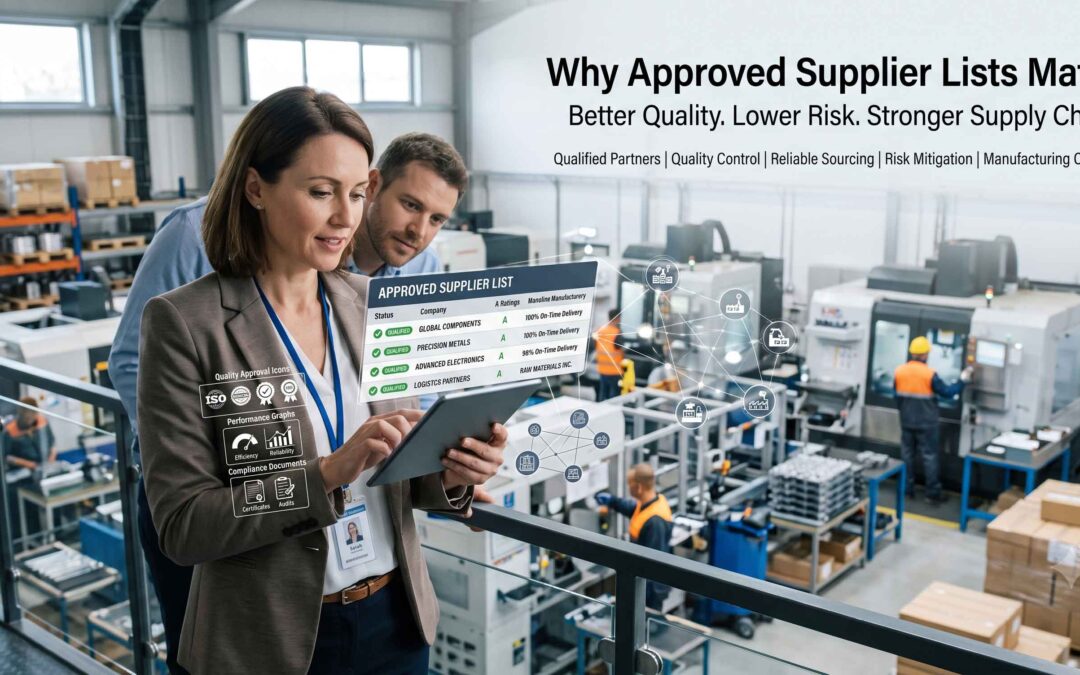
In manufacturing, choosing the wrong supplier can create problems far beyond procurement.
A late shipment can stop production. An inconsistent raw material can ruin batch quality. A documentation gap can delay customer approval. Weak quality controls create expensive rework, complaints, or recalls.
That is why leading manufacturers rely on an Approved Supplier List (ASL)—not just as a database, but as a strategic tool for quality, supply continuity, and procurement efficiency.
What Is an Approved Supplier List?
An Approved Supplier List is a controlled index of suppliers that have been evaluated and authorized to provide specific materials, components, or services to a company.
Evaluation criteria prior to qualification typically include:
6 Strategic Benefits of an Approved Supplier List
1 Reduces Quality Risk
Sourcing from unqualified vendors simply because they offer a lower price leads to rejected materials, production downtime, rework, customer complaints, and emergency procurement costs.
An ASL creates a qualification barrier. Instead of asking "Who can supply this material?", the organization asks: "Which qualified supplier can supply this material consistently?"
2 Improves Procurement Efficiency
Without an approved list, buyers must re-evaluate vendors for every single purchase. With a maintained ASL, procurement teams already know which suppliers pass standards, enabling faster action when requesting quotes, comparing offers, placing POs, or sourcing urgent requirements.
3 Creates Clear Supplier Accountability
Approval is not permanent. Strong manufacturers continuously track key KPIs:
Suppliers that consistently fail expectations can be placed under conditional review or removed, keeping standards high.
4 Supports Supply-Chain Continuity
Depending on a single source exposes your manufacturing process to severe risk during capacity limits, raw material shortages, or logistics issues.
Developing pre-approved alternative suppliers creates vital sourcing options before a crisis occurs.
5 Strengthens Collaboration: Procurement & Quality
Supplier selection shouldn't be a procurement-only decision. While Procurement evaluates pricing and payment terms, Quality evaluates specifications, certifications, and manufacturing controls.
An effective ASL aligns both teams to choose suppliers based on total business value rather than purchase price alone.
6 Builds Deeper Strategic Relationships
Qualification helps identify high-performing vendors worth developing long term. Understanding supplier capabilities allows for collaborative forecast planning, cost optimization, product development, and capacity reservation.
What Makes a Strong Approved Supplier?
Price matters, but price alone rarely creates long-term value. A strong manufacturing partner demonstrates four fundamental pillars:
Consistency
Delivers required quality repeatedly without deviation.
Reliability
Production schedules and delivery commitments are dependable.
Responsiveness
Communicates quickly and takes rapid corrective action when issues arise.
Capability
Has the technical systems, capacity, and documentation to support growth.
The ASL Must Be a Living System
Supplier capabilities change. Management shifts, certifications expire, and capacity expands or shrinks. Manufacturers must periodically review their supplier base and ask:
- Which suppliers are performing exceptionally well?
- Where do we have single-source vulnerability?
- Which categories require alternative qualified sources today?
The Key Takeaway
An Approved Supplier List may look like a procurement spreadsheet, but in reality, it represents the companies you trust to become part of your manufacturing process.
Identifying technically capable and commercially reliable partners before an urgent requirement arises is what makes an entire supply chain resilient.
Read More Articles
The Distribution of Pharmaceutical Demand Across Therapeutic Categories Offers an Important Signal for International Manufacturers Looking at Bangladesh

I quoted less than $600/ from my competitor, but the order closed at $2000/kg, So did they win? Behind the Reason-
Read More Articles

The Missing Strategy Behind Continuous pharma API Sales
Pharma API Business Development The Missing Strategy Behind Continuous Pharma API Sales A good product can win an order. But continuous sales require something more — a strategy for continuously developing the customer and the market. The real question is not only how...

The Desire of Every Business Director- “Sell”
More Articles

You Don’t Always Need an Office in Bangladesh. You Need the Right Market Partner
Read More Articles

Why Product Demand ≠ Market Opportunity

Cross-Functional Approval Matrix: The Strategic Evaluation Framework Every International API Manufacturer Should Understand
Read More Artcle

Your Pharma Portfolio May Have an Opportunity in Bangladesh—But Are You Looking at the Right Products?
ICH Q6A: Chemical Substance Specifications and Test Procedures
Read More Articles

Tablet Granules Consistency & Density (Bulk and Tapped): Critical Quality Factors in Pharmaceutical Manufacturing
When a batch of pharmaceutical tablets fails in the compression room due to capping, lamination, or weight variation, the immediate reaction is often to adjust the machine settings or blame the rotary press. However, experienced production and QA teams know that the...