
The Distribution of Pharmaceutical Demand Across Therapeutic Categories Offers an Important Signal for International Manufacturers Looking at Bangladesh
Bangladesh is an increasingly important pharmaceutical market. But for an international manufacturer, knowing the overall market size is only the beginning.
The more practical question is: Which therapeutic categories are creating the strongest opportunities?
Looking at the distribution of pharmaceutical demand across therapeutic categories can provide an important starting point for answering that question.
🔎 Step 1 — Don't look at the market as one big number
A pharmaceutical market is not one market. It is a collection of different therapeutic segments — each with its own:
- Patient demand
- Prescribing patterns
- Competition
- Local manufacturing capability
- Regulatory requirements
- Pricing dynamics
- Product availability
📊 Step 2 — What does the therapeutic-category distribution tell us?
The chart below provides a snapshot of the distribution across major therapeutic categories.

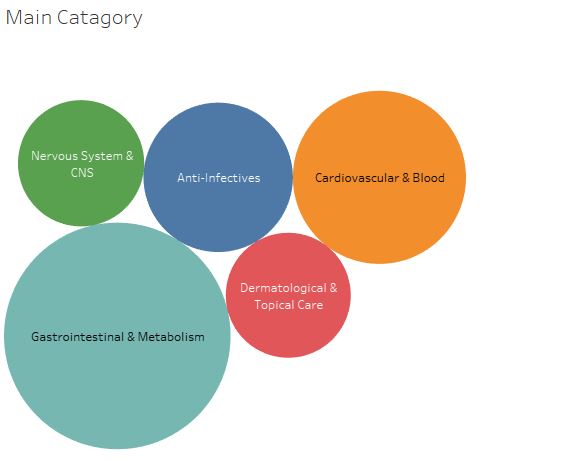
Gastrointestinal & Metabolism represents the largest segment in the dataset shown, followed by Cardiovascular & Blood and Anti-Infectives. Dermatological & Topical Care and Nervous System & CNS also represent meaningful therapeutic areas.
But there is an important point here: A larger category does not automatically mean an easier market. It means there may be a larger pool of demand to investigate. The real commercial opportunity depends on what comes next.
🧩 Step 3 — Turn a therapeutic category into a business opportunity
This is where market analysis becomes useful. Suppose an international manufacturer identifies Cardiovascular & Blood as an attractive therapeutic area. The analysis should not stop there. Instead, the manufacturer can move through a simple process:
This is much more useful than simply saying: “Cardiovascular is a large category.”
🎯 Step 4 — Look at the category from the manufacturer's perspective
For an international API, intermediate, excipient or specialty-chemical manufacturer, the question becomes slightly different.
Instead of asking: “Which products can we export to Bangladesh?”
Ask: “Which products within our portfolio support attractive therapeutic segments in Bangladesh?”
That small change in thinking can completely change the market-development strategy. For example:
Now the market data becomes a product-selection tool, rather than just a statistic.
⚠️ Step 5 — Don't confuse market size with market opportunity
This is one of the most important points.
High demand + very strong competition + aggressive pricing
Moderate demand + limited competition + better product differentiation
Therefore: The largest segment is not always the best segment. International manufacturers should evaluate at least four dimensions:
Is the market actually consuming the product/category?
How many local and international suppliers are already active?
Does the manufacturer offer something commercially valuable?
Can the product be registered, supplied and priced competitively?
🌏 Step 6 — What should international manufacturers do?
Rather than entering Bangladesh with a broad portfolio and approaching customers randomly, a more structured approach could be:
This turns market entry into a process rather than a guess.
💡 The bigger lesson
Therapeutic-category data doesn't tell a manufacturer exactly what to sell. What it does is help answer a much more important question: “Where should we look first?”
And that is often the starting point for a much deeper market-development exercise.
For international pharmaceutical manufacturers, successful entry into Bangladesh may therefore depend not only on having a competitive product — but on choosing the right therapeutic segment, the right molecules and the right local commercial strategy.
One final question for international manufacturers
If you were evaluating Bangladesh today, would you start by looking at the total market size — or by identifying the therapeutic categories where your portfolio has the strongest potential?