
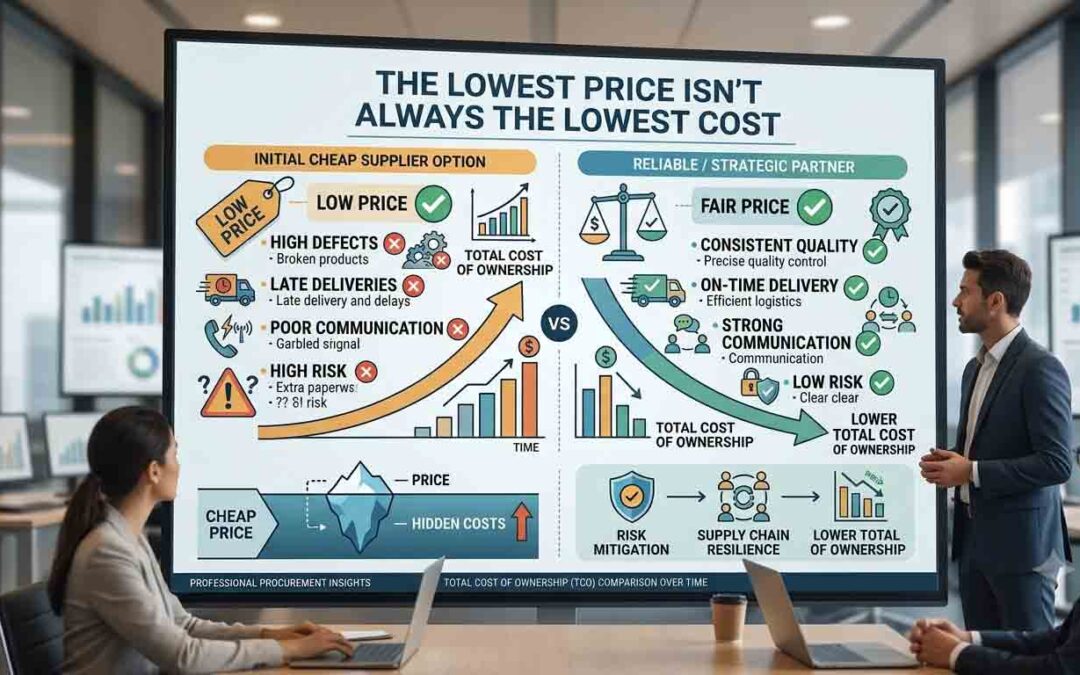
The lowest quotation doesn’t always deliver the lowest cost. Here’s what every procurement and supply chain leader should evaluate before awarding a purchase order.
Imagine receiving two quotations for the same raw material: Supplier A offers $9.50/kg while Supplier B offers $10.20/kg. Most buyers immediately choose Supplier A to save $0.70/kg.
But six months later, the company spends more money with Supplier A. Why? Because procurement isn’t about buying at the lowest price—it’s about buying at the lowest total cost.
The Biggest Procurement Mistake
Many organizations evaluate suppliers primarily by unit price. Experienced teams know purchase price is only a small fraction of total costs. A supplier who appears inexpensive can quickly become the most costly partner when hidden expenses accumulate.
7 Hidden Costs That Don’t Appear on Quotations
1. Poor Product Quality
- Higher rejection rates and production defects
- More quality inspections and waste
- Customer complaints and potential product recalls
2. Delivery Delays
- Production stoppages and idle labor
- Missed customer deliveries and emergency air shipments
- Expensive overtime costs
3. Inconsistent Product Quality
- Constant adjustments during production
- Performing additional batch testing and investigating deviations
- Managing customer complaints
4. Weak Communication
- Delayed quotations and slow document approvals
- Incorrect shipping documents causing customs clearance issues
- Unmeasured, wasted procurement cycles
5. Compliance Risks
- Audit observations in regulated industries (pharma, food, medical devices)
- Shipment rejections and regulatory delays
- Market authorization risks
6. Hidden Logistics Costs
- Poor packaging leading to cargo damage
- Higher freight costs and additional insurance
- Demurrage and detention charges at port
7. High Supplier Risk
- Lack of operational capacity or financial stability
- No business continuity plans or backup facilities
- Sudden supply interruptions that disrupt entire operations
What High-Performing Procurement Teams Measure
Leading organizations evaluate suppliers using a balanced scorecard. Price is just one factor among many:
| Evaluation Criteria | Strategic Focus |
|---|---|
| Purchase Price & Total Landed Cost | Landed cost vs. unit price |
| Product Quality & Consistency | Defect rate, batch stability |
| On-Time Delivery & Lead Time | Schedule reliability, transit safety |
| Communication & Support | Response time, document accuracy |
| Financial Stability & Risk Level | Supplier continuity, capacity |
| Regulatory Compliance | Documentation, audit readiness |
A Real Business Example
Suppose your factory purchases 100 metric tons of raw material annually. Supplier A is 7% cheaper than Supplier B, appearing to save $35,000 annually.
However, during the year:
- Two delayed shipments halt production for two days.
- Three batches fail incoming quality inspection.
- One shipment requires emergency air freight.
- Additional testing increases laboratory expenses and management time.
Result: The company spends far more than the original $35,000 savings.