
Demystifying Pharmaceutical Specifications: The Power of ICH Q6A in Quality Control 🔬✨
In the pharmaceutical industry, bringing a new drug to the global market is a complex journey of precision, safety, and regulatory alignment. At the heart of this process lies a foundational document that changed the landscape of drug development: the ICH Q6A Guideline.
But what actually makes a "specification," and why is it so vital for global health?
📋 What is a Specification?
A specification is far more than a simple checklist. It is defined as a comprehensive list of tests, references to analytical procedures, and appropriate acceptance criteria—which are numerical limits, ranges, or other criteria for the tests described.
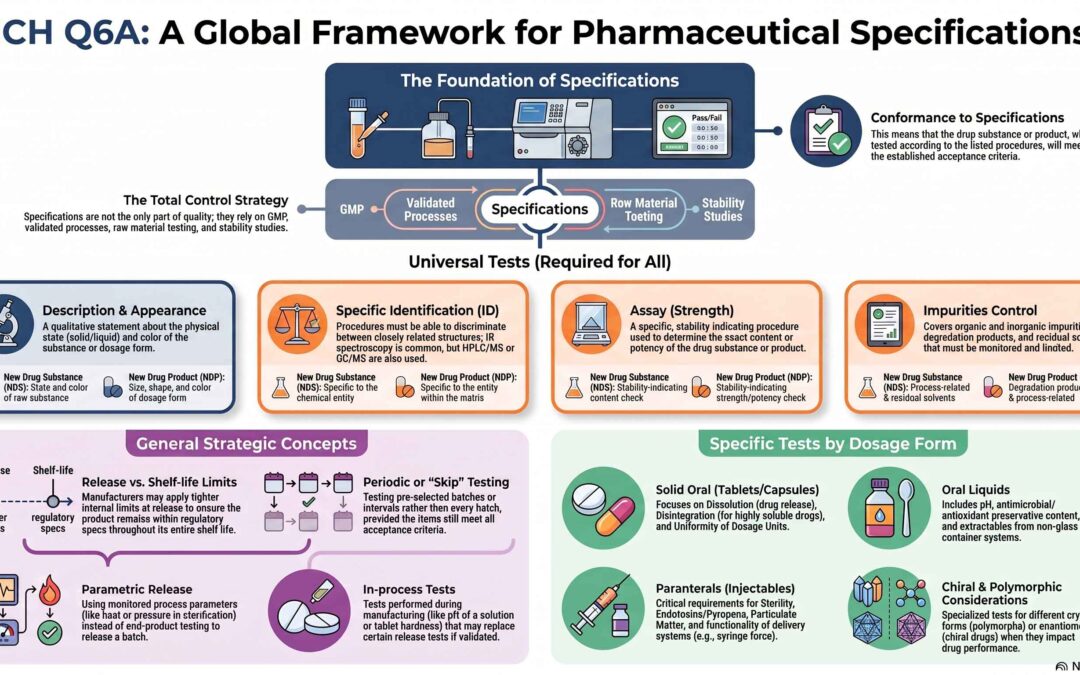
When we talk about "conformance to specifications," we mean that the drug substance or drug product, when tested according to these listed analytical procedures, will successfully meet those acceptance criteria.
These are critical quality standards proposed and justified by the manufacturer and approved by regulatory authorities as conditions of marketing approval.
🌐 The Goal: A Single Global Standard
Before harmonization, navigating different regional requirements was a major bottleneck. The core objective of the ICH Q6A guideline is to assist in establishing a single set of global specifications for new drug substances of synthetic chemical origin and the new drug products produced from them.
This streamlines the registration process across major regulatory regions, including the European Union, Japan, and the United States.
🛡️ Part of a "Total Control Strategy"
It's crucial to remember that specifications do not establish full characterization. Instead, they are chosen to confirm the quality of the drug substance and product, focusing on characteristics essential to ensuring safety and efficacy.
They represent just one part of a total control strategy. True quality and consistency are determined by:
- Thorough product characterization during development
- Adherence to Good Manufacturing Practices (GMP)
- Validated manufacturing processes and test procedures
- Raw material, in-process, and stability testing
🔍 Universal vs. Specific Testing
The guideline categorizes how testing should be systematically approached:
Universal Tests
Potentially applicable to all new drug substances and products:
- Description: Visual appearance
- Identification: Discriminates structure
- Assay: Determines strength/content
- Impurities: Organic, inorganic & residual solvents
Specific Tests
Applicable depending on specific properties and intended dosage form:
- Particle size distribution & polymorphism
- Water content & moisture
- Dissolution/Disintegration (Solid Orals)
- Sterility & Endotoxins (Parenterals)
💡 Forward-Thinking Regulatory Concepts
ICH Q6A supports flexible operational concepts to optimize daily quality control operations:
Release vs. Shelf-life Acceptance Criteria
Manufacturers can establish tighter in-house limits at release to provide increased assurance that the product will remain within regulatory limits throughout its shelf-life.
Periodic or Skip Testing
For parameters like residual solvents or microbial testing in solid orals, testing can be performed on pre-selected batches or predetermined intervals rather than on every single batch, provided it is scientifically justified.
In-Process Testing
Certain tests performed during manufacturing (like pH) can satisfy specification requirements if the acceptance criteria are identical to or tighter than release requirements, and the process is validated.
Parametric Release
In terminal sterilization, monitoring validated physical parameters (like temperature, pressure, and time) serves as an operational alternative to routine end-product sterility testing.
🚀 Looking Ahead: Evolving Technologies
The pharmaceutical landscape is never static. New analytical technologies and modifications to existing ones are continually being developed. When justified, utilizing these evolving technologies offers even greater assurance of product quality.
The Ultimate Objective
Keeping our specifications robust, harmonized, and scientifically justified is how we ensure that patients worldwide receive safe, effective, and high-quality medicines every single day.