
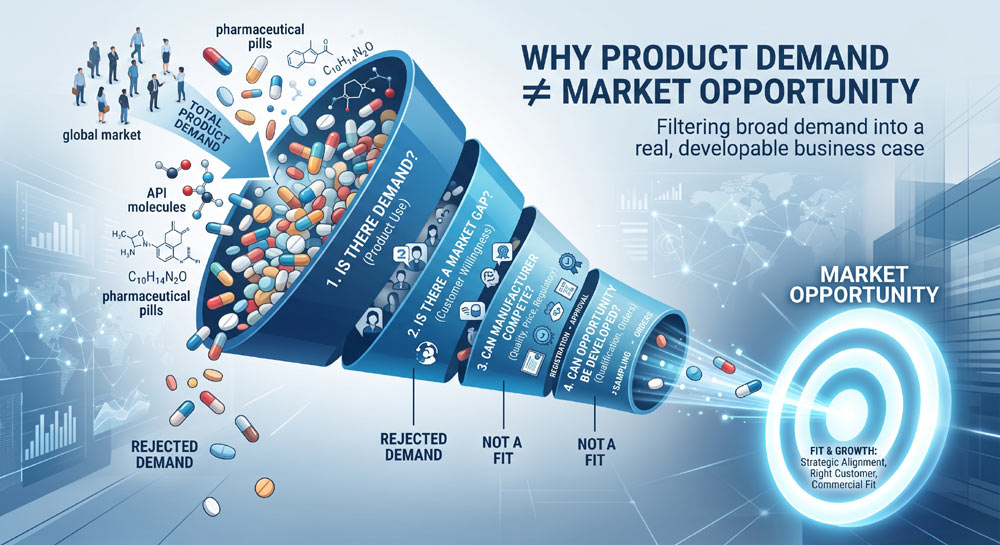
"A product can have demand in a market and still be a poor business opportunity for a manufacturer."
This is one of the most important distinctions I believe international pharmaceutical manufacturers should consider when evaluating a new market such as Bangladesh.
Bangladesh has a strong pharmaceutical manufacturing sector. Local manufacturers meet around 98% of domestic medicinal demand, while the country imports more than 85% of its API requirements.
At first glance, this creates an obvious conclusion:
“There is demand. Therefore, there is an opportunity.”
But the reality is more complicated.
Demand is only the beginning
Suppose a pharmaceutical manufacturer sees that an API is widely used by Bangladeshi manufacturers.
That tells us there is demand for the molecule.
But it does not yet tell us:
These questions determine whether demand can become a real commercial opportunity.
A simple example
Imagine Manufacturer A produces an API that is used by 30 pharmaceutical companies in Bangladesh.
That sounds attractive.
But after looking deeper, we may discover that:
- 25 companies already have long-term suppliers.
- 2 companies cannot use the manufacturer's specification.
- 1 company is already handled by an existing distributor.
- 1 company is not commercially attractive.
- Only 1 may represent a realistic new-development opportunity.
The product has strong demand.
But the manufacturer's accessible market opportunity may be very different.
This is where market development becomes important.
The four layers of a real opportunity
I look at a potential opportunity through four questions:
1 Is there demand?
Is the product actually being used or expected to be used?
2 Is there a market gap?
Are there customers who may genuinely consider an additional or alternative supplier?
3 Can the manufacturer compete?
Can it compete on quality, regulatory requirements, price, supply reliability, documentation and service?
4 Can the opportunity be developed?
Is there a realistic path from identifying the customer to qualification, registration, sampling, approval, commercial order and repeat business?
Only when these layers come together does demand begin to look like a market opportunity.
Why this matters to international manufacturers
When manufacturers enter a new market, it is tempting to start with a catalogue.
“Here are our products. Which ones can you sell?”
But market development should often work in the opposite direction.
Start with the manufacturer's objectives.
- Which products are strategic?
- What is already happening in the market?
- Which channels are already active?
- Where are the gaps?
- Which customers are worth developing?
- What kind of growth does the manufacturer actually want?
This approach can prevent a lot of wasted time.
Because the goal is not to find customers for a product.
The goal is to find the right customers for the right product, under the right commercial conditions, for the right manufacturer.
Bangladesh is not simply a “demand market”
For international pharmaceutical manufacturers, Bangladesh can be an attractive market.
But opportunity should not be measured only by market size or product consumption.
It should be measured by fit.
A manufacturer may have 100 products in its portfolio.
That does not mean all 100 should be developed in Bangladesh.
Perhaps 10 are strategically relevant.
Perhaps 5 have strong customer potential.
Perhaps 2 deserve immediate attention.
Finding those 2 can be more valuable than producing a large list of 100 “potential” products.
This is how I approach market development
My focus is increasingly on understanding the manufacturer first.
What is the company's international strategy?
What are its Bangladesh objectives?
What products does it want to develop?
What customers and channels already exist?
Where does it see growth?
And where can a local market-development effort create additional value without creating unnecessary channel conflicts?
This is the thinking behind Bangladesh Pharma Gateway.
Our objective is not simply to introduce international pharmaceutical manufacturers to Bangladesh.
It is to understand where their products and business objectives genuinely fit within the Bangladesh market — and then develop those opportunities systematically.
Because:
Product demand tells you that a market exists.
Market opportunity tells you that a business can be built.
And those two things are not the same.
What is your experience?
When evaluating a new international market, what do you consider more important: market demand, customer accessibility, competitive positioning, or the manufacturer's strategic fit?

How to Audit a Supplier Before Sending the First Purchase Order
Read More Articles

DMF and CEP: Why They Matter Before Purchasing APIs
Read More Articles

Why Cheap Suppliers Become Expensive Suppliers
Read More Articles

Why Incorrect HS Codes Increase Import Costs
More Articles
Many Importers Don’t Realize They’re Shipping Dangerous Goods Until It’s Too Late
Read More Articles