
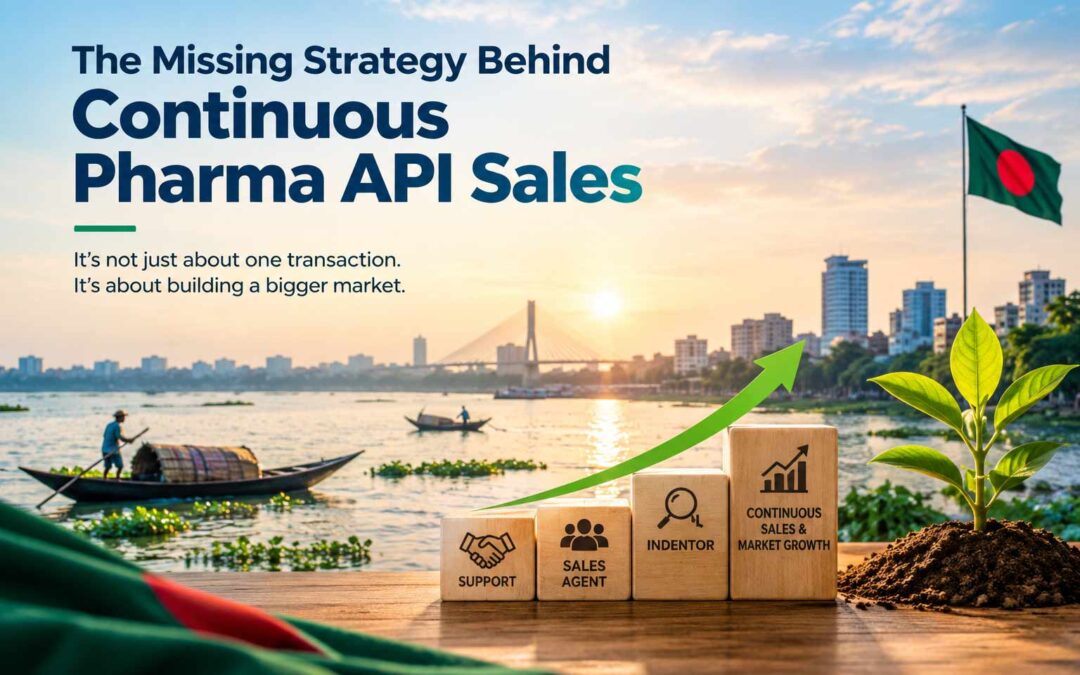
The Missing Strategy Behind Continuous Pharma API Sales
A good product can win an order. But continuous sales require something more — a strategy for continuously developing the customer and the market.
It is: How do you create the next sale?
A customer places an order. You manufacture the product. You deliver it. The transaction is completed.
But what happens next?
Does the customer come back with another order? Or does the relationship simply stop until the next enquiry arrives?
Many manufacturers are already doing good business through individual transactions. But there is another level of growth: developing the market around the product.
This means thinking beyond the individual order and creating a system that continuously supports customers, develops opportunities, solves problems and keeps the business moving.
Because a good product can win an order. But a good market strategy can create continuous business.
Here are three areas where manufacturers can think differently about continuous API sales.
Customer Support Is More Than Delivering on Time
When we talk about customer support, the conversation often starts with:
“We can deliver on time.”
Of course, timely delivery matters.
But in pharmaceutical API business, the customer's journey doesn't begin when the shipment leaves your factory.
The customer may need support across several stages of the supply chain and product-development process.
ICH Q7's GMP guidance for APIs treats manufacturing and quality as a broader system that includes documentation, storage, distribution and the transfer of relevant quality and regulatory information through the supply chain. :contentReference[oaicite:1]{index=1}
Now imagine the manufacturer can confidently say:
“We can support you with the necessary technical and regulatory documentation and coordinate with you through the process.”
That is more than product supply.
You are giving the customer something extremely valuable: confidence to move forward.
And that kind of support can help turn a single product transaction into a longer-term business relationship.
Your Sales Agent Isn't Reaching the Target? Find Out Why.
Suppose you have appointed a sales agent or local representative.
The annual target is clear. But the sales aren't coming.
“The agent isn't performing.”
That may be true. But before replacing the agent, ask a more useful question:
There could be many reasons.
The important thing is to find the actual bottleneck.
A sales target tells you what you want. It does not automatically tell you why you aren't achieving it.
Instead of immediately asking, “Why aren't you selling?” ask: “What is preventing the market from developing?”
Your Indentor May Have Many Principals. But Who Is Giving You Full Attention?
This is another reality manufacturers should consider.
A traditional indentor or trading partner may represent multiple manufacturers.
That's understandable.
But from the manufacturer's perspective, there is a simple question worth asking:
There is a difference between:
“We will inform you when we receive an enquiry.”
and:
“We are actively developing your market.”
The second requires continuous work.
That is a completely different approach from simply waiting for the next enquiry.
And sometimes, the right partner can make a significant difference.
The Real Question Is Not “Who Can Sell My Product?”
The better question is:
“Who is continuously working to develop the market for my product?”
Because selling once is a transaction.
Selling repeatedly is a strategy.
A manufacturer can have a good product, competitive pricing, strong manufacturing capability, good quality and international certifications — and still have an underdeveloped market.
The missing piece may simply be continuous market development.
This is why manufacturers should not look only for someone who can bring an order.
Look for a partner who can understand the market, identify opportunities, develop customers, coordinate internally, communicate externally and keep the process moving.
A Final Thought for Pharma Manufacturers
If you are looking for an A+ result, you need to build an A+ process.
Even when the final result is not perfect, giving your products focused and continuous market attention can move you much closer to the result you want.
Sometimes the missing strategy behind continuous sales
isn't another product.
It's someone continuously working on the market.
BPG works with selected international pharmaceutical manufacturers to develop opportunities in the Bangladesh market through a structured and continuous market-development approach.